Livescore.in Computer Security: game development.

Search This Blog

Popular Posts

Total Pageviews

Showing posts with label game development.. Show all posts

Monday, 30 June 2014

Goal-line technology

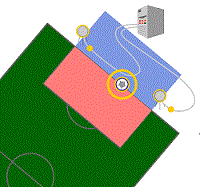
In association football, goal-line technology (sometimes referred to as a Goal Decision System) is a method used to determine when the ball has completely crossed the goal line with the assistance of electronic devices and at the same time assisting the referee in awarding a goal or not. The objective of goal-line technology (GLT) is not to replace the role of the officials, but rather to support them in their decision-making. The GLT must provide a clear indication as to whether the ball has fully crossed the line, and this information will serve to assist the referee in taking his final decision. In the wake of controversial calls made in the Premier League, 2010 World Cup and the Euro 2012, FIFA (previously against the technology) tested potential candidates for goal-line technology. Nine systems were initially tested, but only two remain.
On 5 July 2012, the International Football Association Board (IFAB) officially approved the use of goal line technology. The two systems approved in principle were involved in test phase 2: GoalRef and Hawk-Eye. In December 2012, FIFA announced it would introduce goal-line technology in a competitive match for the first time at the 2014 FIFA World Cup in Brazil. Starting in 2013, in the United States technology has been used in Major League Soccer. However MLS' Canadian teams do not use them in their home games due to the lack of funding. Goal-line technology was also implemented for the 2014 FIFA World Cup held in Brazil whereby the GoalControl system was installed in each of the 12 stadiums.


Background


The question of the inclusion of goal-line technology began to be raised in 2000 as a result of a penalty shootout during that year's Africa Cup of Nations final, when Victor Ikpeba's penalty for Nigeria against Cameroon was deemed by the referee not to have crossed the line after deflecting off the crossbar. To the contrary, television replays showed that it had.[5] Cameroon went on to win the shootout and thus the Trophy of African Unity.
Interest was ignited in the United Kingdom after a game between Manchester United and Tottenham Hotspur in January 2005, in which Tottenham midfielder Pedro Mendes hit a shot 55 yards from goal. United goalkeeper Roy Carroll caught the ball and then dropped it at least a yard over the line before hitting it back out, but neither the referee nor the linesmen saw the ball cross the line.[6] In response to this, FIFA decided to test a system by Adidas in which a football with an embedded microchip would send a signal to the referee if it crossed a sensor going through the goal.[7] According to FIFA president Sepp Blatter, "We did different tests at the Under-17 World Cup in Peru but the evidence wasn't clear so we will carry out trials in junior competitions in 2007".[7] However, those trials did not materialise and by 2008, Blatter had rejected the system outright, describing the technology as 'only 95% accurate'.[7]
Another incident occurred in August 2009 in a league match between Crystal Palace and Bristol City. Striker Freddie Sears knocked the ball over the line from close range, but the ball bounced off the stanchion below the net and then came back out. The goal was not given and Palace manager Neil Warnock was furious.[8][9] In March 2010, the International Football Association Board, which determines the laws of the game, voted 6-2 to permanently ditch the technology, with the Scotland and England football associations casting the dissenting votes. In a recent poll of 48 captains in the UEFA Europa League, 90% of respondents said that they wanted goal-line technology introduced.[10] Following several refereeing errors at the 2010 FIFA World Cup – including the disallowed goal in Germany's 4–1 victory over England, when Frank Lampard hit a shot from outside of the penalty box that bounced off the crossbar and over the line; the ball came back out and the goal was disallowed because the assistant referee did not call for a goal[11] – Blatter announced that FIFA would reopen the goal-line technology discussion.[12]
Another instance of a controversial call was Chelsea’s 2–1 victory over Tottenham in 2011. Frank Lampard hit a shot just before halftime that slipped through the legs of Tottenham's goalkeeper Heurelho Gomes, and almost crossed the line before being tipped back into play, however the assistant called for a goal and Chelsea equalised before going on to win.[13] Chelsea were credited with another goal that did not cross the line against the same opponents in the 2012 FA Cup semi-finals, leading again to calls for goal-line technology.[14]
Before Euro 2012, UEFA president Michel Platini dismissed the need for goal-line technology, instead arguing for placing additional assistant referees behind the goal. However, in a Group D match with Ukraine losing 1-0 to England, the on-field Hungarian officials, Viktor Kassai and István Vad did not see Ukraine's Marko Dević's shot briefly cross the line before it was cleared by England's John Terry.[15]

Tuesday, 18 February 2014

KCSE COMPUTER PROJECT 2013 (KNEC).


  Masomo Bora examination award system

we are suppose to develop a computerized system for a school with this introduction.
Masomo Bora School offers an 8-4-4 system of education. The school offers three exams per term, opener, mid-term and end-term. Students are ranked on basis of average per term.

Form one and two do a total eleven subjects where as form three and form four do 8 subjects. Top performing students are awarded as below


VOUCHER VALUE IN KShs
CLASS
POSITION 1
POSITION 2
POSITION 3
Form 1
1100
900
600
Form 2
1300
1000
700
Form 3
1600
1200
800
Form 4
2000
1500
1000

Table 1: voucher value


Most improved is awarded a badge plus a book voucher worth the second position in their class.

Form 1
900
Form 2
1000
Form 3
1200
Form 4
1500

Table 2:Badge Award

Those who get an average below 40% per term are required to stay for remedial classes.

The school also offers the best performing stream a trip with their teacher included.

from this introduction you can find out  what is required by the knec examiners.

Game development

game development


There are many developers who nurture ambitions about developing mobile gaming apps. Mobile game programming, as you are all well aware, is a different kettle of fish and requires detailed coding for all aspects of the game, at each and every stage.

While it is very difficult to develop code for mobile games, it is also a very rewarding experience for the developer.


Here is a how-to section on mobile game programming.
Difficulty: Average
Time Required: Depends
Here's How:

       Type of Game
    First off, decide on what kind of mobile game you want to develop. There are many categories of games as you know. Choose the category and the kind of audience you want to target with the game. Would you prefer action, RPG or strategy? Are you looking to attract the teen population or a more intellectual set of corporates?

    Only if you choose your type of game will you be able to research the resources available to develop code for the same.
    Programming Language

    You should then decide on the programming language for your mobile game. Usually, J2ME or Brew can help you vastly in your ambitious venture. J2ME offers many more resources for mobile programming in general and mobile game programming in particular.

    Get conversant with the language of your choice and understand all its intricacies, functionalities and device support that it offers. Try to work with the APIs that the language offers.

    If you are interested in developing a 3D type of game, you could maybe try out JSR184 and so on. Experimenting is your key to success.
    Device Specifications
    Get to know the device you want to develop your game for. It is essential that you understand all the specifications of the mobile device, such as processor type and speed, screen size, display type and resolution, image format, audio and video format and so on.
    Game Design

    The game design is a very important factor for developing a mobile game. You have to first plan out the general game design and architecture and think of the multifarious aspects your game will include.

    You start with designing the architecture for the game engine class. If in doubt, do go to online mobile gaming forums and present your question there. Even the smallest lapse will need you to get back to starting from the roots.
    Gaming Knowledge

    Learn up all you need to know about mobile game programming. Read up books and take active part in gaming forums. Talk to experts in the field, in order to gain a better understanding of the system as a whole.

    Also, be prepared to fail at the first few attempts. Know that there are very few game developers that succeed in their very first attempt at coding. You will most probably have to recode several times before you can be sort of satisfied with your work.

Tips:

    Developing a detailed storyline and the different play modes for your game earlier on will help you plan the intricate details of your game at all later stage. So never neglect this stage.
    Build a program skeleton with game programming tools such as Game Canvas. This one comes with an efficient base class, which is especially helpful for 2D game developers using J2ME.
    Try to use an Emulator to test your game, before you actually release it. Of course, you cannot always depend on the Emulator alone. In such cases, you need the exact same mobile device model to check the game on. You could also outsource it to some other company to test your game. Generally speaking, it would be a good idea to learn mobile game programming on a Nokia Series 60 phone.

    In spite of your best efforts, there will be times when you will want to throw your hands up and quit programming. Analyze where the coding went wrong and break up the problem into smaller bits, so that handling it becomes easier for you. Just stick on through the tough times and you are sure to succeed soon enough. All the best to you!
        How Mobile Game Marketing Benefits Game Developers
        Best iPhone Game Developers

What You Need

    J2ME Eclipse
    BREW C and C++ Visual Studio
    Python Eclipse plus plugins
    Flash Lite ActionScript
    Macromedia Flash
    Emulator or device to test the game

Monday, 10 February 2014

Example of a program in java application (program)

Shared using Java Programs With Output(Android app) https://play.google.com/store/apps/details?id=com.freeit.java
 public class BicycleDemo { public static void main(String[] args)
  { // Create two different // Bicycle objects Bicycle bike1 = new Bicycle(); Bicycle bike2 = new           Bicycle();           //Invoke methods on // those objects bike1.changeCadence(50); bike1.speedUp(10); bike1.changeGear(2); bike1.printStates(); bike2.changeCadence(50); bike2.speedUp(10); bike2.changeGear(2); bike2.changeCadence(40); bike2.speedUp(10); bike2.changeGear(3); bike2.printStates(); } } class Bicycle { int cadence = 0; int speed = 0; int gear = 1; void changeCadence(int newValue) { cadence = newValue; } void changeGear(int newValue) { gear = newValue; } void speedUp(int increment) { speed = speed + increment; } void applyBrakes(int decrement) { speed = speed - decrement; } void printStates() { System.out.println("cadence:" + cadence + " speed:" + speed + " gear:" + gear); } }
Hey guys above is a code for a java application please leave your comments.
This is the application that is mos
tly used to create most of this mobile app.