In
association football,
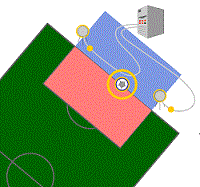
goal-line technology (sometimes referred to as a
Goal Decision System)
is a method used to determine when the ball has completely crossed the
goal line with the assistance of electronic devices and at the same time
assisting the
referee
in awarding a goal or not. The objective of goal-line technology (GLT)
is not to replace the role of the officials, but rather to support them
in their decision-making. The GLT must provide a clear indication as to
whether the ball has fully crossed the line, and this information will
serve to assist the referee in taking his final decision. In the wake of controversial calls made in the
Premier League,
2010 World Cup and the
Euro 2012,
FIFA (previously against the technology) tested potential candidates
for goal-line technology. Nine systems were initially tested, but only
two remain.
On 5 July 2012, the
International Football Association Board (IFAB) officially approved the use of goal line technology. The two systems approved in principle were involved in
test phase 2:
GoalRef and
Hawk-Eye. In December 2012, FIFA announced it would introduce goal-line technology in a competitive match for the first time at the
2014 FIFA World Cup in
Brazil. Starting in 2013, in the
United States technology has been used in
Major League Soccer. However MLS'
Canadian teams do not use them in their home games due to the lack of funding. Goal-line technology was also implemented for the
2014 FIFA World Cup held in Brazil whereby the GoalControl system was installed in each of the 12 stadiums.
Background
The question of the inclusion of goal-line technology began to be raised in 2000 as a result of a
penalty shootout during that year's
Africa Cup of Nations final, when
Victor Ikpeba's penalty for
Nigeria against
Cameroon
was deemed by the referee not to have crossed the line after deflecting
off the crossbar. To the contrary, television replays showed that it
had.
[5] Cameroon went on to win the shootout and thus the
Trophy of African Unity.

Interest was ignited in the United Kingdom after a game between
Manchester United and
Tottenham Hotspur in January 2005, in which Tottenham midfielder
Pedro Mendes hit a shot 55 yards from goal. United goalkeeper
Roy Carroll caught the ball and then dropped it at least a yard over the line before hitting it back out, but neither the
referee nor the
linesmen saw the ball cross the line.
[6] In response to this, FIFA decided to test a system by
Adidas in which a football with an embedded
microchip would send a signal to the referee if it crossed a sensor going through the goal.
[7] According to FIFA president
Sepp Blatter,
"We did different tests at the Under-17 World Cup in Peru but the
evidence wasn't clear so we will carry out trials in junior competitions
in 2007".
[7]
However, those trials did not materialise and by 2008, Blatter had
rejected the system outright, describing the technology as 'only 95%
accurate'.
[7]
Another incident occurred in August 2009 in a league match between
Crystal Palace and
Bristol City. Striker
Freddie Sears knocked the ball over the line from close range, but the ball bounced off the
stanchion below the net and then came back out. The goal was not given and Palace manager
Neil Warnock was furious.
[8][9] In March 2010, the
International Football Association Board,
which determines the laws of the game, voted 6-2 to permanently ditch
the technology, with the Scotland and England football associations
casting the dissenting votes. In a recent poll of 48 captains in the
UEFA Europa League, 90% of respondents said that they wanted goal-line technology introduced.
[10] Following several refereeing errors at the
2010 FIFA World Cup – including the disallowed goal in
Germany's 4–1 victory over
England, when
Frank Lampard
hit a shot from outside of the penalty box that bounced off the
crossbar and over the line; the ball came back out and the goal was
disallowed because the
assistant referee did not call for a goal
[11] – Blatter announced that FIFA would reopen the goal-line technology discussion.
[12]

Another instance of a controversial call was
Chelsea’s 2–1 victory over Tottenham in
2011.
Frank Lampard hit a shot just before halftime that slipped through the legs of Tottenham's
goalkeeper Heurelho Gomes,
and almost crossed the line before being tipped back into play, however
the assistant called for a goal and Chelsea equalised before going on
to win.
[13] Chelsea were credited with another goal that did not cross the line against the same opponents in the 2012
FA Cup semi-finals, leading again to calls for goal-line technology.
[14]
Before
Euro 2012,
UEFA president
Michel Platini
dismissed the need for goal-line technology, instead arguing for
placing additional assistant referees behind the goal. However, in a
Group D match with
Ukraine losing 1-0 to
England, the on-field Hungarian officials,
Viktor Kassai and
István Vad did not see Ukraine's
Marko Dević's shot briefly cross the line before it was cleared by England's
John Terry.
[15]


 Liverpool will sell Brazilian midfielder
Lucas Leiva, 27, to fund their bid for Southampton's Croatian
centre-back Dejan Lovren, 25.
Daily Express
Liverpool will sell Brazilian midfielder
Lucas Leiva, 27, to fund their bid for Southampton's Croatian
centre-back Dejan Lovren, 25.
Daily Express